
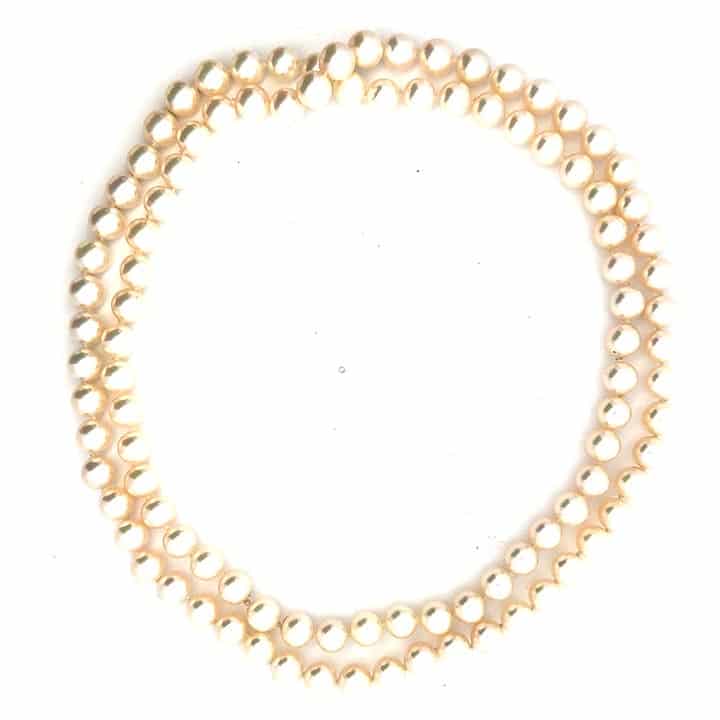

Continuous row of white Japanese Akoya cultured pearls; recently strung and knotted
Total length: 34″ (can be worn double with the use of pin)
Akoya cultured pearls are considered the finest and most lustrous in the world made famous in the 1920’s by Mikimoto, Often taking up to 3 years of undisturbed tranquility to produce maybe two of these pearls of this quality in one oyster.
102 white Japanese Akoya cultured pearls:
Shape: round:
Hues: cream rose:
Luster: High
Surface blemishes: very slight
Match: fine.
Gross weight: 50.00 dwt
Akoya cultured pearls are renowned for their luster and quality, primarily produced in Japan. The history of Akoya pearls dates back to the early 20th century, around the 1920s, when Kokichi Mikimoto, a Japanese entrepreneur, successfully cultivated the first consistently round high quality pearls. Mikimoto’s pioneering efforts in pearl farming revolutionized the industry and established Japan as the leading source of high-quality cultured pearls. Akoya pearls typically range from 2mm up to the much rarer sizes of 8 – 10mm in diameter. They are known for their high luster, which is a result of the smooth, thick nacre that forms around the mother-of-pearl shell and consitantly gentle and clean environments. The color of Akoya pearls can vary, including white, cream, pink, and silver, often with rose overtones. The quality of Akoya pearls is determined by several factors, including:
1. Luster: The reflective quality of the pearl’s surface, which is a key characteristic of high-quality Akoya pearls.
2. Surface Quality: The presence of blemishes or imperfections on the pearl’s surface. Higher-quality pearls have fewer to no blemishes.
3. Shape: While round pearls are the most valued, Akoya pearls can also come in oval, baroque, and semi-baroque shapes.
4. Size: Larger pearls are generally more valuable, although size should be considered alongside other quality factors.
5. Color: The body color and overtones contribute to the pearl’s beauty and desirability.
6. Match: in the case of a necklace of bracelet with multiple pearls, how well the pearls mat h in size hue, luster and blemishes. A finely matched necklace can take years to assemble.
Today, Akoya cultured pearls remain a popular choice for jewelry, valued for their elegance and classic appeal.